Weizhuo Jing’s Website and his analysis of Achilles
Hi! Welcome to my website and the sweet home for Achilles.
At the website, you can learn about his legendary life and Stories.
Hi! Welcome to my website and the sweet home for Achilles.
At the website, you can learn about his legendary life and Stories.
Weizhuo Jing
CLAS 3220
Prof. Chiara
Topic: The Multifaceted Achilles
Achilles, son of Thetis and Peleus, is the king of Pythia which is located in southern Thessaly Unlike Other heroes in Homeric society, Achilles has a mysterious background as his mother is a sea goddess whereas his father is a mortal king of the Myrmidons. The story begins when his mother Thetis decides to eliminate his mortal part by holding one of his ankles and putting him in waters of the river Styx, which indeed made him proof against weapons except the ankle held by his mother. Rearing up by the wise Centaur, Chion, Achilles becomes the strongest man walking on earth. Acknowledging his unusual background and childhood experience , the life of Achilles attracts me right at the beginning as he is the only hero in the Homeric society who retains part of the god’s power. In light of his superstrength over other warriors and his invulnerability, I have been fascinated by him not just because of his power. As mighty as Achilles is, he is also such a unique character in the Iliad who is exceptionally hard to define if only analyzing from one aspect. In this essay, I aim to dissect Achilles in a way that examines his relationship with other characters in Iliad in order to better understand the different roles he played and different personalities he possessed.In Kane’s article “The two Faces of Achilles”, he argues that Achilles has two faces in which first seems to be incompatible, but later proves to exist in harmony. Expanding outside this article, I believe Achilles has shown more than two faces in both Iliad and Odyssey as he behaves in distinctive manners with respect to different characters or at different times.
Achilles as a warrior
The first face that I want to examine is the warrior Achilles and his relationship with King Agamemnon. In chronological order, the first appearance of Achilles in Homeric epic poem Iliad is his role as a Greek Warrior. After the plague was spread in the Greek camp for nine-day, on the tenth day, Achilles called an assembly. This marks the beginning of the Iliad and his story. In this part of the essay, I want to talk about the stubbornness and cruelty of Achilles as a godlike warrior who holds a different belief in the warrior culture and heroic value. In general, the whole Achaean military society is based on the central concept called geras, the prize of honor, and it ensures the proper function of the military system in a way that geat warriors are being expected from the protection of geras.Throughout the whole poem, Achilles was described as a godlike warrior who earns his place by sacking many Trojan cities with a considerable amount of wealth. With invulnerability, mortals can not even post a threat on Achilles during battle. Therefore, the first thing that comes to my mind about the face of Achilles as a warrior is godlike or imply a Demigod. Then, his next characteristic as a warrior ties closely with one of his concubines. Briseis, a form of geras and a material obsession of Achilles, was taken away as a punishment after Agamemnon felt his authority had been threatened when Achilles approaches him in an equal status. Agamemnon’s decision inevitably ruins the warrior culture which the Greek army has relied on, especially for the firm believer like Achilles. At this point, I can feel the fury and rage inside Achilles when the heroic value system that he supports for a long time is undermined, resulting warriors and cowards are being equally respected. As a result of this reckless action, Achilles not only becomes exceptionally angry and upset about his loss of Briseis as he has been deprived of his honor, but also feels sad about the reality so he withdraws from the battle and swears an oath of never rejoining the war except his ship is in danger. Without the help of a godlike warrior, the Greek falls back little by little, and the balance slowly turns to the Trojan. At this time, Agamemnon realizes that he makes a huge mistake in offending the top fighter, and he tries to fix the relationship between Achilles and him by sending an embassy along with countless fortunes to express his regret. Not surprisingly, all members of the embassy can not get this job domne. Ajax fails to appeal to Achilles with the warrior’s shame culture. Even Phoenix, who is literally a father-like role in Achilles’ life, can not move Achilles’ mind through detailed reasoning of the benefits to accept the compensations. Though this embassy does not bring Achilles back to the war, it certainly changes the way he assesses his relationship with Agamemnon and others. We can see in Iliad that Achilles indeed changes his mind continually from deep resentment toward Agamemnon and the Greek army toward a more gentle mood when they ask for help. Given this mental reconstruction of Achilles, he still stands firmly by his final promise. Thus, the ultimate failure of the embassy explicitly manifests Achilles’ stubborn characteristic as he still sticks to his oath without any compromise when dealing with outsiders.Furthermore, in Sale’s article “Achilles and Heroic Values”, the author argues that Achilles’ ultimate return to the battlefield is also an indication of his stubbornness toward the warrior culture. From my point of view, the author’s argument absolutely makes sense when we think about losing his armor. The third characteristic of Achilles as a warrior is the cruelty and dehumanization. After the death of Patroclus, he basically turns into a killing machine, as efficient as a shark and pitiless, with only one goal-hunting down Hector. In Iliad book 22, there is a scene in which Achilles indicates his cruelty through his response “ I wish my stomach would let me cut off your flesh in strips and eat it raw” when Hector begs him to let Priam ransom the dead body. When I first read this part, it is instantly shocking and exceptionally hard to believe that this kind of degradation exists in a heroic character. This animal-like behavior shows me the dark side of Achilles and brings me a deeper insight into human nature.
In this part, from my perspective, Achilles’ face as a warrior exposes his worst part to the public. To break down the analysis, the role as a warrior indeed links to some negative characteristics. No matter how honorable a man is, being a warrior always means to use violence for personal desire, which inevitably presents the worst of a human.
Achilles As a Friend
The second part of the analysis will focus on Achilles’ role as a friend in the Greek army. Referring back to the time when the first embassy was sent to seek help from Achilles, Ajax and the others fail to persuade Achilles to rejoin the war. However, the next time Ajax comes, he changes his strategy to urge Achilles by requesting as a friend, a comrade who fights alongside him for ten years. Personally, I believe this strategy apparently evokes another aspect of Achilles who regards responsibility as the top priority. Ajax appeals to Achilles smartly this time by surpassing the name of Agamemnon and asking in the name of himself. In this way, Achilles feels bad about his misconduct of the obligation of friendship between him and Ajax and his distance of social love. Therefore, he then permits Patroclus to join in the battle with his armor. Stubborn as he is, Achilles, at last, shows sincerity as a friend to save the Acheneans even though he is still socially aloof from others, holding himself back from the battle.
In this part, The role of a friend is expressed through his relationship with the Whole Greek Army, especially his relationship with other great warriors like Ajax. As a friend, Achilles does have sympathy and some traits of softness in his heart, but his stubborn warrior part restrains him from fully expressing his kindness. Therefore, the role of a friend and that of a warrior is constantly intertwined with each other. Interestingly, his softness and kindness as a friend exists in harmony with his stubbornness and cruelty as a warrior.
Achilles As a Lover
Unlike the two previous roles mentioned in this essay, from my perspective, Achilles’ role as a lover is the most fascinating one as it can be dissected in the aspect of being Briseis’ partner and Patroclus’s partner.
Firstly, Achilles wins Briseis over by slaughtering all the people in which she inhabits. Though Briseis is a material obsession, Achilles equates Briseis to his wife and disregards her status as a war prize. In Iliad Book 19, When Briseis saw Patroclus’ dead body, she mourned him with these following words “ you told me you’d make me Achilles’ bride, told me you’d take me on a ship to Pathia, for a wedding among the Myrmidons. I will never stop grieving for you, forever sweet.” Though the promise to a marriage with Achilles is made by Patroclus, given the close relationship between Patroclus and Achilles, it is reasonable to infer that Patroclus is confident about Achilles’ love toward Briseis. Additionally, we can also deduce the status between Achilles and Briseis by reading the part where a comparison is drawn between the typological images of Zeus and Hera, Paris and Helen, and Achilles with his Briseis. The former two couples are bonded by marriage, literally meaning the sharer of bed. Though Achilles is never able to live the life he desires, he loves for Briseis is certain.
Furthermore, though Homer does not write in Iliad, speaking from my view, Achilles also shows a genuine love toward Patroclus. After the death of Patroclus, Achilles basically went off his mind and was immersed by undesirable grief so overwhelming that he was in no mood to eat or drink until the fall of Hector. They must share a deep connection with each other as Achilles is able to sense the dead soul of Patroclus. There is an interesting sentence in the Iliad that implicitly conveys the notion of homosexuality when Patroclus requests Achilles “don’t bury my bones apart, but mix them with yours so that in death we’ll be together as in life”(Tom, 6). Usually, men bury themselves with the one their love such as their wife or concubine whereas warriors are usually left alone in the darkness. Through this burial request, it gives me a hint that Patroclus indeed indicates an authentic affection. Being sure that Patroclus places Achilles in a special place which is far beyond a friend and a commander, the next thing we want to make sure is that Achilles also shares the same kind of feeling.
Luckily, through the intricate examination of Achilles’ words and action, I found Achilles also regarded Patroclus more than a friend. Before the death of Patroclus, Achilles responds to the request of the embassy with a strong sense of selfishness by pointing out he’d rather give up the enormous glory but to live a normal life. Additionally, in Odyssey book 11, when Odysseus travels to the underworld, Achilles answers him by “ Don’t try to sell me on death, Odysseus. I’d rather be a hired hand back on Earth”. Moreover, in Iliad Book 9, Achilles expresses his wish for a happy domestic life at home with his bride several times. Together, in these scenes, Achilles articulates his desire for a normal life to reinforce the notion that he ‘d rather be an ordinary guy with no glory at all rather live a short but glorious life. However, the death of Patroclus completely changes his mind, Knowing his fatal death will come right after the end of Hector, Achilles still chases Hector without hesitation even if it costs him his life. From my point of view, there is only one power that is strong enough to overcome the fear of death, and its name is love. Honestly, I do not believe in a word that Achilles met his death because of the affirmation of glory or unimaginable friendship with all the evidence in the Iliad and Odyssey. Deep down, similar to other mortals, godlike Achilles is also afraid of Hades but his love toward Patroclus overcomes this fear.
In this part, Achilles as a lover breaks so many conventions and restrictions in Homeric society like a marriage based on unequal status and homosexuality that further fortify my notion that this is the most interesting role he plays in his life. Apart from that, in my opinion, the audience can resonate with the lover Achilles as it provides us with a mortal character who shares the same feelings such as fear and love.
Achilles as a father and son
Similarly, in Iliad, Homer does not explicitly examine Achilles’ role as a son. When Priam comes to the Greek camp alone to ransom Hector’s dead body, the old king of Troy evinces a more profound sense of suffering as a parent who loses his dear child. Priam then appeals to Achilles by emphasizing the sorrow he will endure for the rest of his life of not having his children with him. It reminds Achilles of his father Peleus far from the land of Troy who is probably as old as Priam. In this situation, Achilles feels guilty of not being able to stay by his father’s side to perform a son’s duty. Therefore, knowing his unchangeable destiny, Achilles instead shows the filial affection toward Priam to get rid of his guilt of not being a qualified son. Besides, there is another scene in Odyssey Book 11 also expresses his guilt and affection toward Peleus when Achilles met Odysseus in Hades. Even though Achilles is no longer alive, he still concerns about whether his father is being respected as usual. Together, though Achilles might not fulfill a standard requirement of being a good son, his intention to do his job and constant concern of his father’s wellbeing make him at least a dutiful and responsible son.
Adding on, as a father, we can perceive Achilles’ expectation of his son to be a great warrior like him from his inquiry “ Did he come to the war and take his place as one of the best”. This is the only section in both Iliad and Odyssey that attaches Achilles to his son. The audience can still have a grasp on the new face of Achilles as a typical father who always wants his children to overcome or take his place.
In conclusion, each face of Achilles presents us with completely different characteristics and various aspects of him. More importantly, by examining the different roles, I now realize that Achilles is such a complicated character who has diverse personalities which first seem to be incompatible in a person such as cruelty and responsiveness . Yet, after dissecting Achilles in different aspects and at different stages, surprisingly, these traits coexist within Achilles smoothly but only in different faces of him. The characteristics of multifaceted makes him stand out from the rest in Homeric society. For instance, when we think of Odysseus, we normally describe him as a master of strategy, the most distinctive characteristic that he possesses. However, it is not the case for Achilles since he has acquired so many different characteristics at the same time, which is again the reason why makes him so special and attractive.
Reference for secondary sources
Tom Sleigh. (2006). Achilles’ Dream. The Kenyon Review, 28(2), 13-17. Retrieved April 1, 2020, from http://www.jstor.org/stable/4338871
Sale, W. (1963). Achilles and Heroic Values. Arion: A Journal of Humanities and the Classics, 2(3), 86-100. Retrieved March 3, 2020, from www.jstor.org/stable/20162854
KANE, T. (1976). THE TWO FACES OF ACHILLES. CEA Critic,39(1), 4-6. Retrieved March 3, 2020, from www.jstor.org/stable/44370408
Bibliography source 1:KANE, T. (1976). THE TWO FACES OF ACHILLES. CEA Critic,39(1), 4-6. Retrieved March 3, 2020, from www.jstor.org/stable/44370408
Firstly, before analyzing the content, the title of this article is attractive as it directly points out a distinctive feature of Achilles which reminds me of a famous figure in ancient Chinese history who also shares multiple personalities.
In this article, the author directly points out there are two views of Achilles. One is the cold-blood killer, as efficient as a shark and pitiless whereas another is the gentle warrior, embracing his enemies in acknowledgement of their joint suffering. From my perspective, these two traits of Achilles at first seem to be incompatible or even contradictory to one another. Yet the author explains in this article that these two different faces of Achilles are not only intimately related, but also imply a profound comment upon idealism. Then, the author mentions that the hero’s commitment to glory is the key to unlocking the myth of an intimate relationship between the two faces of Achilles.
In the author’s analysis, Achilles quit the war because he questions the warrior’s arete when Briseis is taken away, which is a loss of honor. As a result, Achilles believes that cowards and brave men are equally respected. He also implicates that he will return if Agamemnon has been sufficiently humbled. All of these actions taken by Achilles represent his concern for a hero’s glory. At this part of the article, the author has an unusual claim that is quite different from what I have read in other passages, which attributes Achilles’ ultimate return to an affirmation of glory rather than anger and guilt over Patroclus. Therefore, the immediate result of a total commitment to glory and dedication to the ideal of the culture that Achilles’s belief is savagery and dehumanization as a brutal killer through his conversation with Hector “I only wish I could summon up the appetite to carve and eat you raw”. The audience can realize that Achilles does not stop killing because of the tragic limitation of martial glory, which requires the constant sacrifice of life. Yet, he recovers from it when Priam evinces a more profound sense of suffering as a parent which unites humanity. In the last part, the author points out that the two faces of Achilles are not a contradiction, but rather a phrase of the hero’s evolution.
To conclude, the madness of Achilles and his sick ideal of glory or his culture is like a dark valley that drowns him at first. But that is also the reason which makes him more like a human than an immortal god as the affirmation of will and glory is usually submitted to mortality. Achilles, like a few other high spirits, finally passes through this dark valley when he spares the life of the old king at Troy. This article provides me with a deep understanding of the commitment to glory. More importantly, the author gives an insightful analysis of Achilles as a moral being by examining the affirmation of will and glory. Throughout this article, I believe most of the information is astute. However, in my own opinion, we can not deny that the death of Patroclus is a determining factor that drives Achilles back to the war.
Bibliography Source 2: Sale, W. (1963). Achilles and Heroic Values. Arion: A Journal of Humanities and the Classics, 2(3), 86-100. Retrieved March 3, 2020, from www.jstor.org/stable/20162854
This article is a close examination of Achilles’ heroic value at the beginning of this article. The author points out to his audience that the whole Achaean military society is based on the central concept called geras, the prize of honor. In this article, Briseis is described as a form of geras, a material obsession of Achilles. Hence, the audience can easily understand why Achilles becomes exceptionally angry and upset about his loss of Briseis as the article refers to Briseis to a symbol of honor, which is the essential value that Achilles believes. Additionally, I learn from this article that geras is the most important value that a hero treasures, and it acts as a propeller to ensure the proper functioning of the military system.
For the first time, I see an author choosing a side between Achilles and Agamemnon in their quarrel by explicitly claiming that Achilles’ withdrawal from the battle is morally justified. Furthermore, the author condemns the reckless action taken by Agamemnon when he decides to take away Briseis as a punishment to Achilles and also a movement to indicate the king’s nobility. By taking this action, Agamemnon does the worst thing he has ever -he shattered the heroic value system. The author comments that the society which Achilles dwells in is so entirely repudiating the value on which it is based, and it has little claim to the loyalty of the man it has so grievously wronged.
Reading through the whole article, I find out that the author is continuously holding Achilles back by writing how Achilles’ situation worsens after he withdraws from the war. In this article, Achilles is portrayed as a worthless foreigner who isolates from his community, without social status as a result of Agamemnon’s improper action. In the next part of the article, the author explains Achilles’ corresponding behaviors and words with a phrase “when a man has been so outraged that his faith in society is undermined, he will do and say things in anger which he might not fully mean.” From my perspective, the author is finding an excuse for Achilles to cover up his mistakes.
To conclude, this is an interesting article which provides me with insight from a person who strongly supports the course of actions taken by Achilles. It also raises another question of whether Achilles is morally right or wrong to withdraw from the war as a warrior, especially as a heroic commander in the military.
Bibliography source 3: Tom Sleigh. (2006). Achilles’ Dream. The Kenyon Review, 28(2), 13-17. Retrieved April 1, 2020, from http://www.jstor.org/stable/4338871
This article is fundamentally different in both structure and content compared to other passages that I have read so far. The author in this article depicts Achilles’ emotional stage after the death of Patroclus through Homeric style by writing a poem-like essay and adapting some parts of the Iliad. Unlike the contemporary article, this one utilizes a different text structure with more pausing between sentences.
At the beginning of this article, the author does not directly provide the audience with a clear timeline. Instead, it portrays a sorrow picture in which Achilles alone stood outside the tent staring at the darkness whereas other soldiers fell asleep. With a poetic tone and phrasing, the author let the audience envision the mindset of Achilles, and easily engage the readers to resonate with the feeling of Achilles. This characteristic is what makes this passage unique as it tells the story just like Iliad rather than writing analysis.
Reading on, we can learn that the timeline is right after the death of Achilles from” Achilles. How can you sleep? When I was alive, you didn’t neglect me. But now, in death, you’ve forgotten me. Bury me, Achilles–” It is not hard to infer from these callings that Patroclus and Achilles were very close when these two great men still alive. They indeed share some bond between them as Achilles can feel the dead soul of Patroclus. At this part, I now start to wonder is there any special feeling(love) between these two men just like other legends record. There is an interesting sentence in this passage “Achilles: don’t bury my bones apart, but mix them with yours so that in death we’ll be together as in life” which further vindicates my thought of a special relationship between these two warriors. In my common sense, soldiers are usually barry alone when they died during a fight, whereas lovers generally stay together till the end of their lives. Therefore, it is reasonable to deduce from Patroclus’ request that, at least, Patroclus shows a genuine love toward Achilles.
To refer back to another bibliography that I write in this assignment, I think this article strengthens my argument which Patroclus is a crucial reason why Achilles rejoins the war. To conclude, this passage provides us with the freedom of imagination of the relationship between Achilles and Patroclus, and I believe these two warriors share a strong bond wich beyond healthy friendship between each other.
Bibliography source 4: Robbins, E. (1993). The Education of Achilles. Quaderni Urbinati Di Cultura Classica, 45(3), 7-20. doi:10.2307/20547207
Bibliography source 5: McCloskey, Benjamin (2017). Achilles’ brutish Hellenism: Greek identity in the « Herōikos ». Classical Philology, 112(1), 63-85.
Bibliography source 6: Asplund, C., & Best, T. (2013). Achilles tendon disorders. BMJ: British Medical Journal, 346(7899), ‘29-33. Retrieved April 1, 2020, from http://www.jstor.org/stable/23493997
For Theme Bibliography :
Bibliography source 1:Papakonstantinou, Z. (2009). Wine and Wine Drinking in the Homeric World. L’Antiquité Classique, 78, 1-24. Retrieved April 4, 2020, from http://www.jstor.org/stable/antiqclassi.78.1
This article provides a close examination of the uses of Wine and its social significance, as depicted in Odysseus. I found this article exceptionally interesting because it relates xenia to an actual object-wine.
To begin with, the author states that Wine is the most common beverage of Homeric society with many different uses. One of them is to act as a symbol of Xenia. Commonly, the host will follow the established ry=ules of xenia regarding feasting and wine consumption. For instance, When Odysseus finally sailed back to Ithaca, the swineherd served Odysseus with Wine and good food even though he did not figure out the beggar is Odysseus. In this context, the Wine serves as a gift of xenia for the guest to help them settle down.
Additionally, according to the author’s statements, drinking is inevitably and quintessentially a social act that is usually carried out by members of elites in Homeric world to conform the basic requirements of being a host( e.g rules of xenia & including gift exchange to acknowledge the equal social status between the host and the guest). There is another example that can also testify to the idea that Wine acts as a gift or tool for upper-class people to perform xenia. When Telemachus first reached Nestor’s land, he was offered with food along with a beautiful cup that filled up with vintage eleven-year-old Wine as a drink and libations for the guest. We have been informed that the Wine is intentionally sealed up for years in Pylos to aim at elevating the xenia. These two examples from Odysseus indicate that Wine is indeed a standard drink that has a function of performing xenia in the Homeric world.
To conclude briefly about this article, the author draws the association between Wine and aristocratic xenia in primarily two ways. Firstly, Wine can be used in the context of gift-exchange, where people from the same hierarchy. By doing this, Wine serves as a medium to consolidate peer relationships through the goodwill of xenia. Secondly and most commonly, the consumption of Wine highlight the importance of the social occasion for both host and guest just like exchanging gifts when you dear friends decide to leave. Overall, this article provides many solid reasons why wine can presents xenia to the guest.
Bibliography source 2: Belfiore, E. (1993). Xenia in Sophocles’ Philoctetes. The Classical Journal, 89(2), 113-129. Retrieved April 4, 2020, from www.jstor.org/stable/3297661
In this article, the author studies the words, gestures and actions associated with the topic of xenia in Philoctetes. At the beginning of this article, the precise definition of xenia has been given to the audience “ a ritualized relationship or a formal relationship entered into between two members of different social groups, and manifested by the exchange of goods and services.” With this notion in mind, the audience can distinguish between xenia and kinship & friendship as these three relationships share some similar traits.
The author starts to introduce xenia to his audience by providing several preliminary steps to initiate xenia. At here, I noticed that the author uses a temporary to describe the bond created by xenia. I believe the author is trying to imply that, unlike friendship and kinship mentioned previously in the article, the relationship of xenia is less reliable for people to count on. In my mind, Xenia is more like a form of politics between people who share equal social-status but have different backgrounds
Then the article describes how Sophocles’ Philoctetes indicates the importance of the concept of xenia by using a weapon. In the first part of the play, the prefix of Xen- words occurs twice in the first line spoken by Neoptolemus’s sailors. Throughout the whole passage, the author expands the topic of xenia through the discussion of a bow. Like many other weapons, the bow has another functional value besides using it to fight in the war, which is a xenia gift. Never left Philoctetes’ hands, this bow is seen as untouchable as well as sacred. In the exchange of this bow, this weapon bonds three persons including Neoptolemus, Philoctetes, and Heracles. At this part, I now comprehend why the hero’s weapon weighs so much to another warrior. In exchanging arms or merely giving out weapons as a gift, this links the kleos with xenia. In the last part of Odysseus, Odyssey stops Telemachus from further trying to string the bow when his son nearly handles the challenge. I agree that Odyssey is afraid of losing his Kleos if his son successfully overcomes the task. Hence, we can reasonably infer that using weapons as a xenia gift means a lot to warriors.
To sum up, after reading this article, I now wonder in what circumstances can people determine this xenia bond is a temporary one or a long-lasting one.
Bibliography source 3: Tracy, C. (2014). The Host’s Dilemma: Game Theory and Homeric Hospitality. Illinois Classical Studies, (39), 1-16. doi:10.5406/illiclasstud.39.0001
This article argues that xenia or hospitality can not have functioned so well as Homer described given the selfish nature of humankind. By retrieving the theory of Darwin’s fromThe Origin of Species, at the first page of this article, the author conveys his opinion which altruism has no place in the survival of the fittest. What makes this article stand out from the others is that it incorporates game theory in the analysis of hospitality. With this new approach, the author intends to show that Homeric hospitality(xenia) follows some mechanism in Game theory.
The author firstly admits that some examples show genuine hospitality like Menalous offers food and gifts to Telemachus without recognizing him as the son of Odyssey. Then, she opens up her argument that the hospitality system does not work in Homeric society as numerous examples show the failure of hospitality as well. In Odyssey book 10, Circe’s magical attack on Odyssey’s crew indicates that a brutish host can bring severe damage to guests. Other examples like Penelope’s suitors plotting to kill Telemachus show that guests can potentially threaten the wellbeing of the host. Generally, there are three reasons for why people are conducting the xenia when strangers come: 1) Gods demand it 2) the hero’s claim to participate in reciprocal behavior 3) the desire for glory. Yet the author crushes these three reasons one by one through providing detailed examples like Heracles does not get punished by Zeus even if he disobeys God’s will to show hospitality.
Right after the counterarguments for the hospitality system, the author explains the reason why Game theory is a superior method in understanding Homeric Hospitality. Prisoner’s dilemma is a mathematical model that can predict human behaviors according to the selfish nature of people. The article explains that xenia is only performed under the circumstance in which both parties are equally benefited. As soon as one side of the party has more advantages over another, it will not hesitate to break the hospitality system to gain more benefits just as Penelope’s suitors or Heracles. From my perspective, I like the way that this article narrates as it does not deny the system of hospitality or simply make a statement that rejects the whole xenia thing. On the contrary, the author makes a concession and then gives her reasonings. At last, the game theory indeed provides a more in-depth insight into the hospitality system for us with a better understanding of how hospitality(xenia) works.
Bibliography source 4: Verheij, M. (2016). Hospitality & Homicide: Violation of xenia in Euripides’ “Electra”. Mnemosyne, 69(5), fourth series, 760-784. Retrieved April 4, 2020, from www.jstor.org/stable/24772109
Bibliography source 5: BLAKE, S. (2011). MARTIAL’S NATURAL HISTORY: THE “XENIA” AND “APOPHORETA” AND PLINY’S ENCYCLOPEDIA. Arethusa, 44(3), 353-377. Retrieved April 4, 2020, fromwww.jstor.org/stable/44578371
Bibliography source 6:HERMAN, G. (1990). TREATIES AND ALLIANCES IN THE WORLD OF THUCYDIDES. Proceedings of the Cambridge Philological Society, (36 (216)), new series, 83-102. Retrieved April 4, 2020, from www.jstor.org/stable/44696683
Xenia, a bond of trust or a genuine guest-host friendship, usually generates affections and obligations toward a guest who is in approximately the same social status of the host. This form of hospitality in the Homeric society is regarded as divine and disciplinary for every city in Rome and Greek as people believe it is in gods’ will to establish this affectionate bond between travellers and domestic dwellers. Additionally, from another perspective, hospitality is also seen as the pursuit of political and economic interests as the guest-host relationships play a peace-keeping role in ensuring bilateral trades and forming political alliances with other states.
In Odysseus, the Homeric epic poem, Xenia is commonly expressed through providing accommodations and setting up banqueting rooms for festival enjoys at central sites. But, generally speaking, the beginning of this friendship had to be marked by ceremonial performance. During the invitation of this ritualized friendship, several crucial events take place consecutively-a solemn declaration, gifts exchange, a handshake between the host and the guest, and feasting. Moreover, in Homeric society, bath and reclothing the guest are two other critical steps in indicating hospitality as these actions led to greater integration of the stranger into the domestic social and fit in with the host. In Odysseus book 4, Menelaus offers a decent meal before inquiry about the bloodline of the stranger. Additionally, a considerable amount of treasures are given to Telemachus even though it is the first time they meet with each other. Also, in book 8 and 9, accommodations and bath are provided 1 Odysseus to fit in the society.
However, interestingly, this ritualized friendship is not eligible for all citizens in Greek and Rome. Only a small minority of people from the upper-class institutions are qualified for showing their warmth as they own enormous fortunes and can be easily identified by titles like “hero”, “godlike”, “king”. For instance, in Odysseus book 7-8, When Odysseus finally reaches Phaeacian Kingdom, he intentionally sits in the ashes awaiting for the response from the host . At this time, a wise old man, Echeneus, notices that it is contrary to the value of Xenia to let a guest sitting improperly in the ashes, but he is still saying “we are all holding back, waiting on your word.” In this situation, Homer implicitly points out in his poem that only people with power at hand can perform this special friendship.
Additionally, people in the higher social hierarchy often exchange valuable resources, involving nominated gifts or the performance of specialized services like catering every need proposed by the guest. Therefore, these networks are often regarded as a tool to perpetuate class distinctions. Furthermore, the core value of these networks is the exchange of designated goods and services as they created what later to be known as the networks of ritualized friendship.
In the Homeric world, especially in Odysseus, this special guest-host relationship is critical to the heroes as they found this friendship is mainly personal, and it can be seen as a form of political and military alliances. Hence, Xenia is a perfect substitute for kinsmen or a protector by providing sanctuary. Speaking from an economic standpoint, these networks offered elites substantial benefits as they usually served as mediators between their kings and their community of origins. Therefore, it is also in elites’ economic interest to maintain these networks. To conclude shortly, Xenia appears almost everywhere in the Odysseus. It must be the essential value that Homer believes in to tie different people from diverse kingdoms.

Peter Paul Rubens. “Achilles Discovered by Ulysses Among the Daughters of Lykomedes at Skyros.” painting, Art, Archaeology, Architecture(Enrich Lessing culture and Fine Arts Archives) 246x267cm
Rubens, a Flemish artist, was famous for his usage of the unique Baroque style, which emphasized on the movement, color, and sensuality in painting mythological and allegorical subjects. The subject of this painting is Achilles responding to the sound of a trumpet. By arguing that a woman would not make the same reaction as a man does, holding a sword on the hand, Odysseus reveals the trick and engages Achilles into the Trojan war. In this portrait, the use of color is what makes this painting stand out from its counterparts. From my perspective, Rubens intentionally painted Achilles with a red dress, which is the brightest color in the scene, to indicate he is the main character of this portrait. On the contrary other female characters are placed in a less significant place as they all wear light color dresses. Hence, as an audience, the thing that I noticed first is the shining red dress, and then I turn my sight on other details of this portrait like the sword and jewels. Additionally, Rubens embraces multiple colors in his painting which enables a superb visual experience for the audience. It is also interesting to see the facial expression of the women who stand behind Achilles, especially the one with blue dresses. They show the audience a feeling of mockery toward Achilles as they already know Achilles is disguised as a woman, and wish somebody to unveil the truth. In this sense, I can kind of resonate with the heroes in Iliad who regard the honor of a soldier as the most important thing as they are easily held back by others’ opinion. Moreover, there is another detail in this painting that I find very interesting. Only male characters show their arms with no cover on their masculine bodies. Personally, I would say this resembles the power of men and their dominant role in society. To conclude, this painting depicts an important stage in Achilles’ life which he steps into his fate predetermined by prophecy.
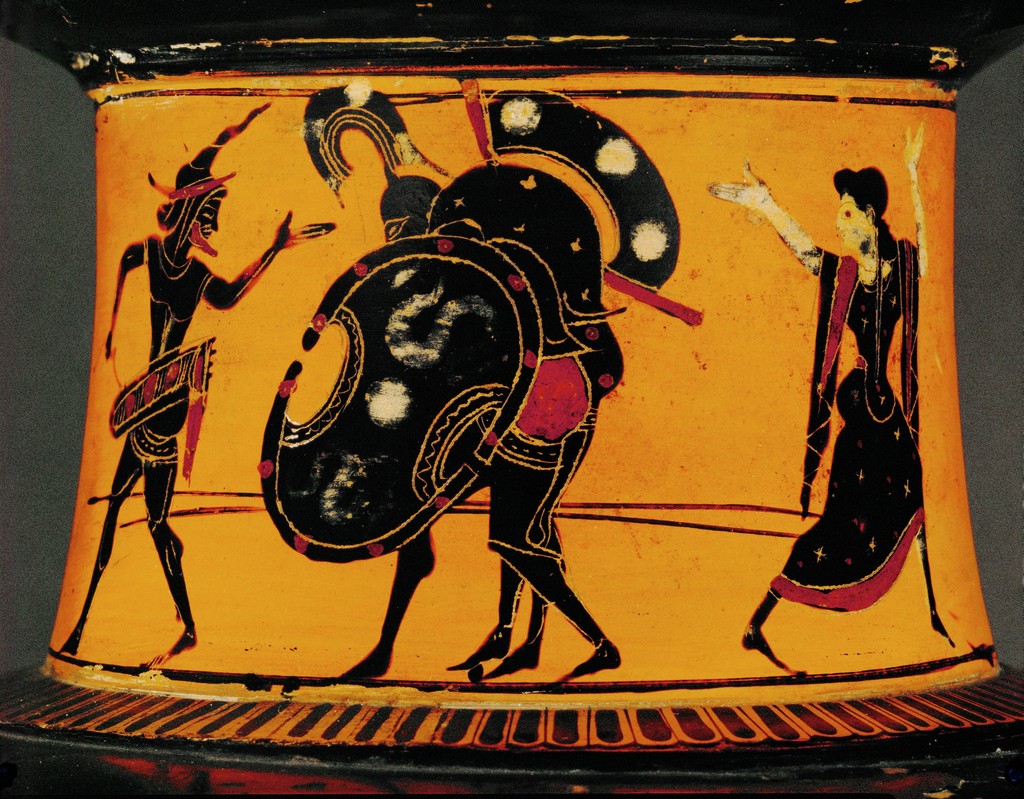
Antimenes Painter. “Amphora with Ajax Carrying the Body of Achilles, detail of the neck. “ (520-510 BCE). MusΘe du Louvre, Paris, France. Vessel,
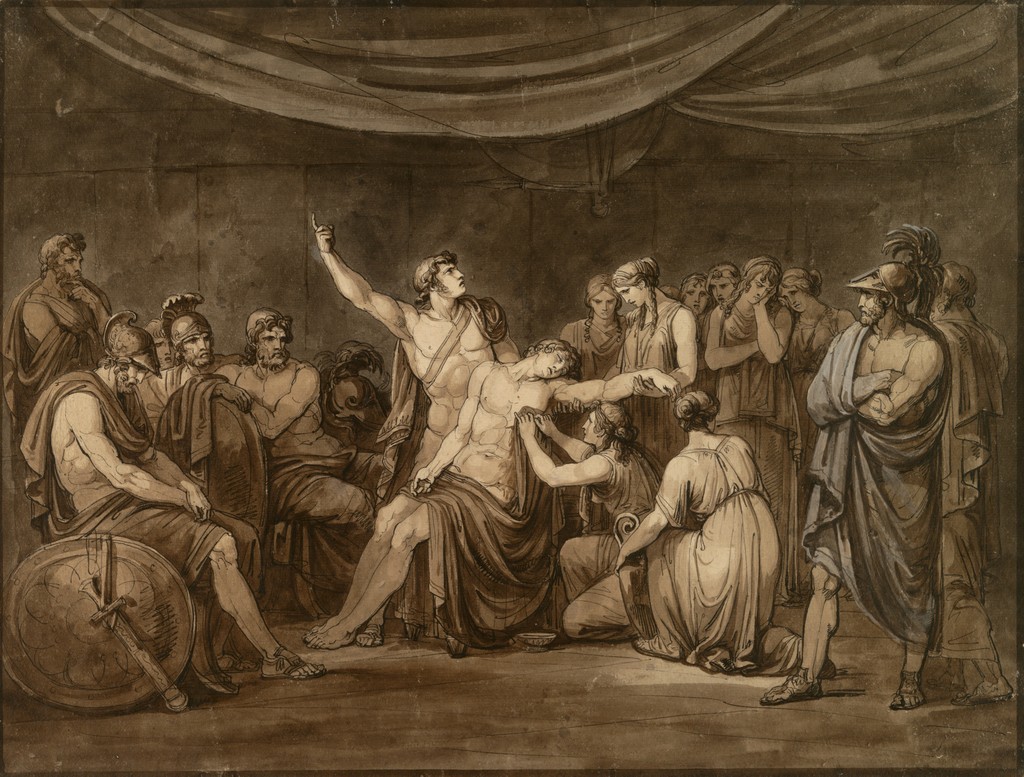
Bartolomeo Pinell “Achilles Swears an Oath to Avenge the Dead Patroclus, Killed by Hector.” 1808, Works on Paper, Yale University Art Gallery, Overall: 41.3 x 54.6cm (16 1/4 x 21 1/2in.); Framed: 64.77 x 77.47 x 3.175cm (25 1/2 x 30 1/2 x 1 1/4in.)
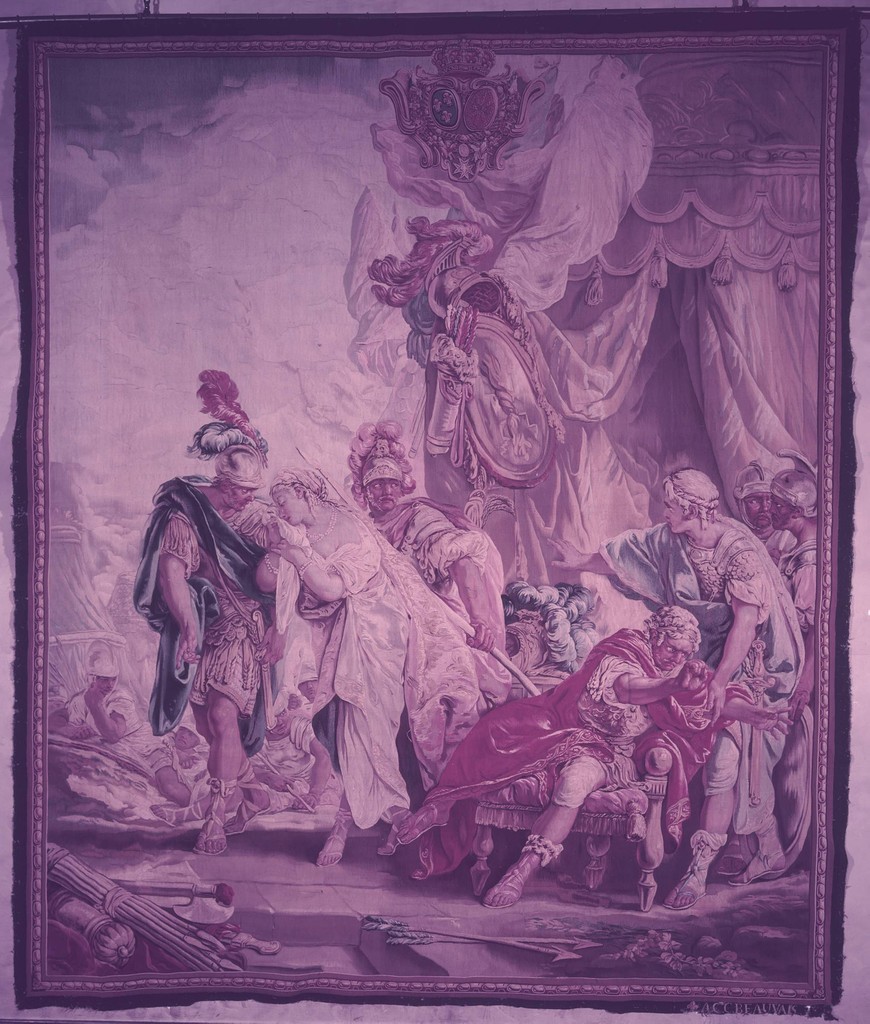
Deshays de Colleville, Jean-Baptiste-Henri “Quarrel of Achilles and Agamemnon, wrath of Achilles, Illiad, Set A” 1729-1765. Beauvais, Textiles-Tapestries, 12’x 10’4’’
Deshays, a french painter, is famous for painting religious and mythological subjects. He adopted the grand manner, a term used to describe paintings that utilize visual metaphor to indicate the nobility of a subject. The theme of this painting is Achilles quarrelling with Agamemnon while his beloved Briseis has been taken away by the heralds Talthybius and Eurybates. We can analyze this painting in two ways. Firstly, this portrait stresses Agamenon’s nobility and his power as he is crowded by men and the only one who sits on a chair. These traits resemble the nobility of Agamemnon and his superiority compared to other characters.
Additionally, Agamemnon conveys his unquestionable authority by letting his man arming with weapons inside the camp. Secondly, by looking closer at the picture, the audience can sense the intimacy between Briseis and Achilles as she grasps Achilles’ hands with nostalgia and reluctance. Adding on, we can see Achilles’ eyesight lingers on Bresis when Agamemnon’s fellows take her. From my perspective, it is quite surprising that these two characters share such a strong bond as Briseis is only a prize of the war allocated to Achilles. When reading about Iliad, I thought about what Achilles cares about is his stubborn sense of honor. Yet, in this picture, seeing them holding hands together like a couple just falls in love with each other, I now feel like Achilles is more like a human rather than a godlike warrior depicted in Iliad as he shares some moral traits in this picture. Hence, the audience at that time can relate themselves with Achilles.
After going over this painting, I still wonder about which character represents Achilles as there is no clear sign of his trait. Later on, I realize that maybe this artwork can be analyzed in different ways by viewing from different perspectives. The one who sits on the chair might also be Achilles himself as he turns over his head and tries not to look at Briseis when Agamemnon’s fellows take her. Interpreting his facial expression, I found this character shows an upset mood which might further justify my idea that he is Achilles.
Overall, I strongly prefer the first interpretation as this explanation presents us with a different Achilles who are now more flesh and blood.
Question 8:
In Book 6, Hector replies his wife firstly with a concession, saying that he also worried about the same situation himself. By admitting that he also wants to retreat from the frontline and stays behind the wall, he acknowledges that Andromache offers a reasonable request to him as his wife. Yet, he emphasizes his honours as a commander of the Trojan army, and this title means he should stand on the very frontline of this battle to lead his soldiers. To me, Hector is such a complexed character that shows both selfless and selfish aspects in a simple conversation. From my perspective, his decision of rejecting Andromache’s proposal can not be judged with moral criteria as he values the broad definition of family(Ilion) more than the family of his own—-the narrow one. In this sense, Hector is selfish to his wife and his little son but selfless to his people. Frequently, warriors who engaged in the war can not be perfect in balancing both his personal issues and his duty.
In Homer’s world, men treasure their honours and responsibilities to their city, especially if they have specific job titles. In Iliad, it is always the most important thing for men to win glory and respect from allies on the battlefield through the talk between Hector and Paris. He believes in a society which men and women both stay in their positions. Warriors go to the battlefield while women perform waits in the city and pray to gods for victories. However, women share a different point of view which they usually regard her marriage/ husband as the fundamental thing in lives just like what Andromache says to Hector—-The marriage is the only thing she left. So basically Hector means all to her and what she believes to be a good society is plain and simple in which Hector stays by her side. Still, the difference in values which men and women possess finally leads to a tragic ending for most families in trojan.
Blog Post Two
I found this article very persuasive as the author employs many scholars’ argument and the overall tone for this passage is very objective. “ And I want to emphasize here again that this is not about pathologizing individuals. This is not about anyone’s personal mental health. This is a cultural problem of dysfunction and social organization that has neither simple explanation nor simple solution” This part provides the audience with the author’s insight on toxic heroism as he believes it is not an individual phenomenon rather than a collective behavior. From my perspective, this sentence is indispensable to this article as it conveys the audience with a sense of objectivity by illustrating the logic behind the author’s argument.
In Sophocles Ajax, the main character displays the toxic heroism in the same way as the author describes. After failing to inherit Achilles’ legacy—his armor, Ajax feels that he has been disrespected and dishonored. Thus, holding the notion of heroism, Ajax turns himself against the Greek army because of his sick sense of honor. He tries to kill the high king Agamemnon, his brother Menelaus, and Odysseus, the man who takes over Achilles’ armor for revenge. Fortunately, Athena saves them by exerting illusion on Ajax and makes him believe that he has fulfilled his desire. There will be a catastrophic disaster if Ajax does complete his revenge in which the Greeks might lose their ten-year efforts.Just like what the author argues in his passage, toxic heroism is always related to a man’s honor. Even now, some criminals commit felony only because they feel ashamed or being dishonored . Hence, the toxic heroism is now still poisoning the social well-being as it posts a threat to safety issues
Blog Promo Three. Question 1
The first encounter is confronting the song of Sirens, who always bewitch all men and make them unwelcomed by wife and children. To deal with this problem, The crews have sweet wax in their ears which prevents the lure lyrics from interfering with their mindsets. Moreover, Odysseus himself has been tied up on the ship as he decides not to miss the chance to hear the Sirens singing. The second encounter is facing Scylla, an evil monster that even a god would not be glad to see. Sailing upon the narrow channel, Odysseus and his crew clash with this monster right in the face. Without mentioning a word about Scylla, Odysseus loses six of the best men from his ships in this part of the journey. The perfect island of the Sun marks the last encounter. It is this place that ruins all the efforts that Odysseus put on his way home. Because of Eurylochus and his lousy advice, Odysseus and his crew have been punished by Zeus as his crew members betray their oath and slaughter cattle and cows without noticing Odysseus.
Cueva, Edmund, Harrison, Stephen and Mason, Hugh (Eds.). (2018). Rewiring the ancient novel. 1, Greek novels. Groningen: Barkhuis. 127-150
The fragrance of the rose: an image of the voice in Achilles Tatius. (2017). In Voice and voices in antiquity / (Vol. 396, pp. 416–432). Leiden ;: Brill,.
González González, M. (2018). Achilles /. Abingdon, Oxon ;: Routledge,.
Arieti, J. (1985). Achilles’ Guilt. The Classical Journal, 80(3), 193-203. Retrieved February 18, 2020, from http://www.jstor.org/stable/3296724
Generally speaking, this article provides a close examination of the new culture and value that Achilles embraces and his sense of guilt.
In the first half of this article, the author opens up with presenting the quarrel between Achilles and Agamemnon with Agamemnon grows angry first because he believes that the conservation should be downward communication rather than the lateral one. Therefore, he takes away Briseis as a punishment to Achilles’ arrogant attitude toward the king, who is in a superior hierarchy. This action resulted in the withdrawal of Achilles’ army during the Trojan war. The author deliberately presents the contrast between the traditional culture and value held by the general public and what Achilles’ belief, and this is implied by the firm stance of Achilles’ promise. Both Phoenix and Ajax fail to persuade Achilles with a warrior’s common shame-culture”. However, Achilles is moved by the speech as he feels bad about his misconduct of obligation of friendship between him and Ajax and his distance of social love. Therefore, he allows his closest friend, Patroclus, to wear his armor and aid the Greek army.
In the second half of this passage, the author shifts his focus from revealing the traditional culture of the Greek to the new culture adopted by Achilles alone. After the death of Patroclus, Achilles is immersed in enormous guilt and profound regret that he does not take his responsibility as a helper and a protector of his present situation. The author claims that, in this way, Achilles acts like no other man in Homeric society because of his new perception of his responsibility.
Interestingly, this article suggests Achilles commits suicide as he has always been informed that his death will come after that of Hector. The overwhelming guilt brought by the death of Patroclus serves as an internal motive of Achilles to find his new glory–killing Hector. It is at the time when Achilles lends his armor to his closest friend that his fate is fixed. After killing Hector, he also takes away his ego and life. The author states that Achilles has suicidal behaviors through analyzing Achilles’ weird actions, which include abstinence from food and abandonment of his sexual life, implicating the unbearable guilt is the cause of his death.
Lastly and most importantly, the author ends up notifying his reader that Achilles raises the poem to a monumental level in humanity, and initiates the search for a brand-new morality in Homeric society, which is based on individual responsibility rather than collective opinions.
Scodel, R. (1989). The Word of Achilles. Classical Philology,84(2), 91-99. Retrieved February 14, 2020, from www.jstor.org/stable/270264
This article focuses on Achilles’ characteristics and the influence of his word during the time when the Greek army retrieves back to their camp. It suggests that Achilles is a hero who commits to straightforward relationship between thought and word, word and action. In other words, his stubbornness and the strong sense of self-esteem which holds him back from rejoining the war. Though Achilles changes his mind continually from deep resentment toward Agamemnon and the Greek army to a more gentle mood when they ask for help , he still stands firmly by his final promise. Hence, the passage argues that he does not allow himself to act inconsistently, particularly in public matters ,because he once promised that he would not fight until the fire reaches his ship. In Iliad, Agamemnon sends Odysseus to persuade Achilles with enormous gifts for compensation. Yet, Achilles refuses the proposal at once, showing no desire for gifts.Thus, the author presents Achilles with his stubbornness through his response to Odysseus and his reaction to the compensations.
Stubborn as he is, Achilles indeed shows sincerity by sending patroclus to save the Acheneans. This indicates Achilles’ veracity even though he is still socially aloof from others,holding himself back from the battle. In this part, the author conveys to his reader that Achilles does care about the Acheneans, which indicates another characteristic of his personality. He does have sympathy and some traits of softness in his heart, but his stubborn nature restrains him from fully expressing his kindness.
Finally, the article examines how the word of Achilles reveals deeper problems in the Greek army. By only reporting the initial part of Achilles’ response, Odysseus tricks others through spreading fake news that Achilles is sailing home and encourages them to act the same. In this part, the author is trying to present his audience with the toxic environment inside the Greek camp where heros have misunderstandings among themselves .The distorted communication and information asymmetry leads to exacerbated hate toward Achilles. From this perspective, the article dissects the Greek army in a way that offers his audience the evidence of social failure, and indicates how the word of Achilles affect the situation during the battle.
Wright, I. (2016). The Wife of Achilles. Mnemosyne, 69(1), fourth series, 113-118. Retrieved February 14, 2020, from www.jstor.org/stable/24772033
This article is a close examination of the tragic ending of Achilles, and the role of Briseis in his life.At the beginning of this article, the author opens up the discussion by pointing out how Achilles lives a tragic life through “Achilles slept in the innermost of the well-built hut and with him slept beautiful-checked Briseis.” The article argues that Achilles has long been wishing for a happy domestic life at home with his bride mentioned in Iliad Book 9 several times, so the audience can realize the mindset of Achilles. This makes him more human as the desire to go home reflects a person’s selfish perspective. Then, the article lets the audience know his inability to fulfill his desire because of his unchangeable destiny–die at Troy. By drawing a comparison between the typological images of Zues and Hera, Paris and Helen, and Achilles with his Briseis, the author further reinforces his claim that the tragic isolation that Achilles embraces as the former two are bonded with marriage, literally meaning sharer of the bed. However, Achilles never married Briseis in his life, which indirectly conveys the message of isolation to his readers.
Furthermore, I think this article is useful in two ways.Firstly,it provides the audience with the information that, deep in Achilles’ heart, he already equates Briseis to his wife and disregards her status as a warprize by referring back to Iliad Book 19(297-299). This addresses my curiosity as I have long been wondering how significant Briseis is as Achilles withdraws from the war. Secondly, throughout the whole article, the author sticks to his point by repeatedly mentioning Achilles is a hero who lives a tragic life with inability to satisfy his personal desire, and emphasizes on his sacrifice in order to attain undying glory. Thus, the audience of this article is able to comprehend what the author is trying to convey, and have a general idea of a sad story of Achilles even though he wins a supreme glory for himself
Lastly, after going through this article, as a reader, I think this passage opens up a question for me to consider whether it is worth it for Achilles to sacrifice his life to earn the undying glory as he plays multiple roles in his world as a warrior,a husband, and a son. There might be different opinions on this question if we analyze at a different angle. Therefore, the author successfully triggers the interest of his audience and engages them in thinking further questions.
Achilles, son of Thetis and Peleus, is the king of Pythia which located in southern Thessaly. His mother, Thetis, frequently put herself in the affairs of human and immortals while his father, Peleus, a mortal king of the Myrmidones in Phthiotis who shares a mysterious background as he married with the goddess Thetis. Together, they give birth to Achilles, a significant character described in Homer’s Iliad. When Achilles was a kid, his mother wanted to eliminate his mortal part by holding one of his ankles and putting him in waters of the river Styx, which indeed made he proof against weapons except the ankle held by his mother. In contrast, other legends tell that, without the knowledge of Achille’s father background, Thetis put on son in a glowing fire overnight to burn down the mortal part inside Achilles. As soon as Peleus found out his son is writhing on the fire, he cried out, and Thetis left them for good but, still, kept an eye on his offspring. It has to be the predetermined fate and prophecy of Achilles to talk about first to understand this complex character. Themis prophesized that whoever marries with Thetis, as long as he is an immortal, will have an offspring mightier than his father, and he will have a short but glorious life. Throughout his entire childhood and even when he matured, his mother Thetis always strive to unchain him from his fate.
Taught by Chiron, the wise Centaur living in Mount Pelion, Achilles grew up strong and wild, disobeying his teacher and indulging in what he thought to be good time—damaging the surrounding village. Later on, without giving up to save her beloved son, Thetis disguised Achilles as a girl and sent him to Scyros under the name of Pyrrha who is Achille’s sister to escape his determined death. However, his true identity was discovered by Odysseus when war approached. By using a trumpet, Odysseus revealed the trick and reasoned that a girl does not react to the sound as a man does. Therefore, when Achilles was fifteen, he became the leader of the Myrmidons and led them against troy.
In the tenth year of the war, The high king Agamemnon insulted the priest of Apollo who had to pledge him to ransom his daughter taken away from him as a prize for victory and disregarded his proposal arrogantly. As a result, Apollo placed a plea in the Achaean army almost decimate the entire troop to revenge for the priest. After acknowledging what had happened in the army, Achilles described Agamemnon as a man who already takes the lion’s share and to profit by other’s effort without battling himself. The king got utterly displeased and punished him by taking away his sweetheart Briseis. At the meantime, Achilles considered killing Agamemnon due to his disrespectful decisions. While he pondered, Athena came down to him, seized him by his hair, and stayed his temper. Although Achilles gave up his notion of slaughtering king Agamemnon, he withdrew from the war and stayed in his tent following Agamemnon’s action. Without the aid of Achilles and his army, the Trojans were able to push forward in the battle filed, came closer to the coastline, and succeeded in setting fire on Greek ships. Finally, Achilles consented to send his best friends Patroclus back in the warzone to stop the Trojans from further offensive attacks, but he did not forecast the death of his closest friends who had been killed by Hector.
When the message finally passed down to Achilles, he was immersed by unspeakable pain and regrets as he could have saved his friend if he did not stand aside from the war. Driven by enormous rage and strong will to put things alright, Achilles asked Thetis to have him a new armour and accepted his fate to die after the fall of Hector. Achilles reconciled with Agamemnon without asking for any compensation, but Agamemnon himself gave back Briseis along with seven unfired tripods, ten gold bars, twenty burnished cauldrons, seven cities, and several other magnificent gifts. Little interests in these gifts, Achilles slaughtered countless trojan warriors without eating any food or drink until he finally killed Hector who he chased thrice during the war. He then tied Hector’s dead body to his chariot and dragged it back to Greek’s ships. It is precise as his fate indicates that, after the death of Hector, Achilles was slain by the Trojan prince Paris and Apollo at Scaean gate when he was on his way to see Polyxena, daughter of Priam. Hence, the legendary life of Achilles came to an end without mentioning explicitly in Homer’s Iliad.
Reference
Leiden, B(2005), Menelaus, Brill’s new Pauly,
Parada, C(1997), Menelaus, General Guide to Greek Mythology Characters, http://www.maicar.com/GML/index.html
Spawforth, A., Eidinow, E., & Hornblower, S. (n.d.). The Oxford classical dictionary(4th ed. / general editors, Simon Hornblower and Antony Spawforth assistant editor, Esther Eidinow.). Oxford: Oxford University Press.
Smith, W(1870), Menelaus, ENCYCLOPEDIA MYTHICA, Dictionary of Greek and Roman Biography and Mythology, https://pantheon.org/articles/m/menelaus.html
 Weizhuo Jing