
Peter Paul Rubens. “Achilles Discovered by Ulysses Among the Daughters of Lykomedes at Skyros.” painting, Art, Archaeology, Architecture(Enrich Lessing culture and Fine Arts Archives) 246x267cm
Rubens, a Flemish artist, was famous for his usage of the unique Baroque style, which emphasized on the movement, color, and sensuality in painting mythological and allegorical subjects. The subject of this painting is Achilles responding to the sound of a trumpet. By arguing that a woman would not make the same reaction as a man does, holding a sword on the hand, Odysseus reveals the trick and engages Achilles into the Trojan war. In this portrait, the use of color is what makes this painting stand out from its counterparts. From my perspective, Rubens intentionally painted Achilles with a red dress, which is the brightest color in the scene, to indicate he is the main character of this portrait. On the contrary other female characters are placed in a less significant place as they all wear light color dresses. Hence, as an audience, the thing that I noticed first is the shining red dress, and then I turn my sight on other details of this portrait like the sword and jewels. Additionally, Rubens embraces multiple colors in his painting which enables a superb visual experience for the audience. It is also interesting to see the facial expression of the women who stand behind Achilles, especially the one with blue dresses. They show the audience a feeling of mockery toward Achilles as they already know Achilles is disguised as a woman, and wish somebody to unveil the truth. In this sense, I can kind of resonate with the heroes in Iliad who regard the honor of a soldier as the most important thing as they are easily held back by others’ opinion. Moreover, there is another detail in this painting that I find very interesting. Only male characters show their arms with no cover on their masculine bodies. Personally, I would say this resembles the power of men and their dominant role in society. To conclude, this painting depicts an important stage in Achilles’ life which he steps into his fate predetermined by prophecy.
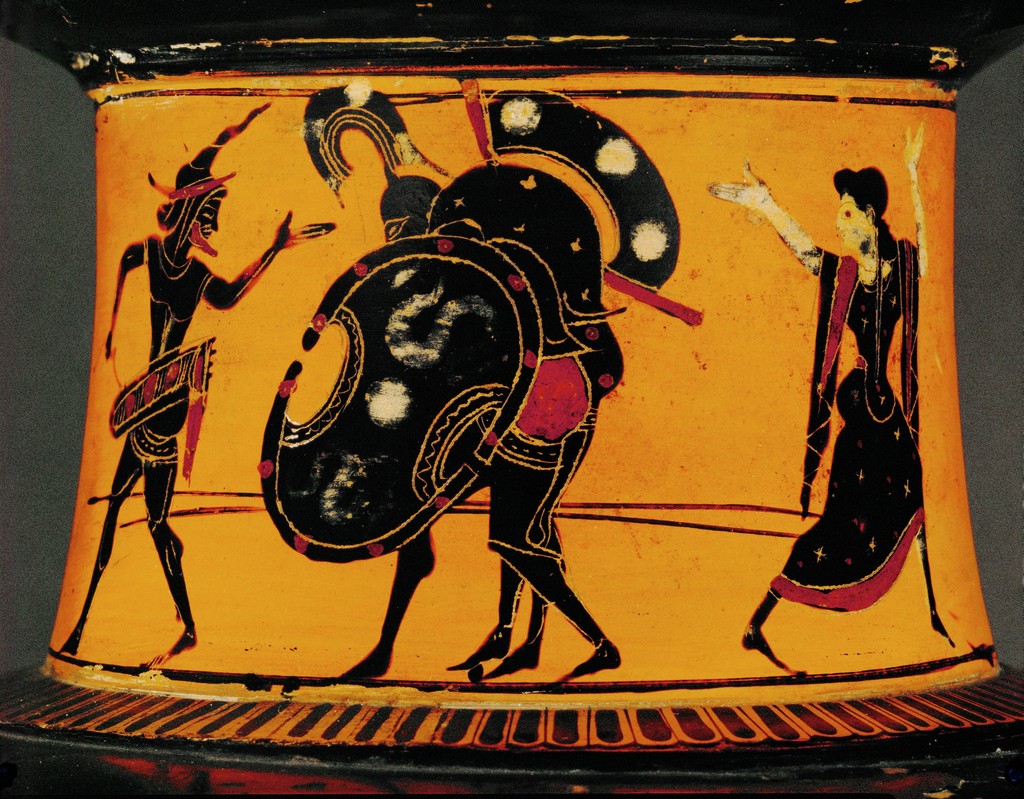
Antimenes Painter. “Amphora with Ajax Carrying the Body of Achilles, detail of the neck. “ (520-510 BCE). MusΘe du Louvre, Paris, France. Vessel,
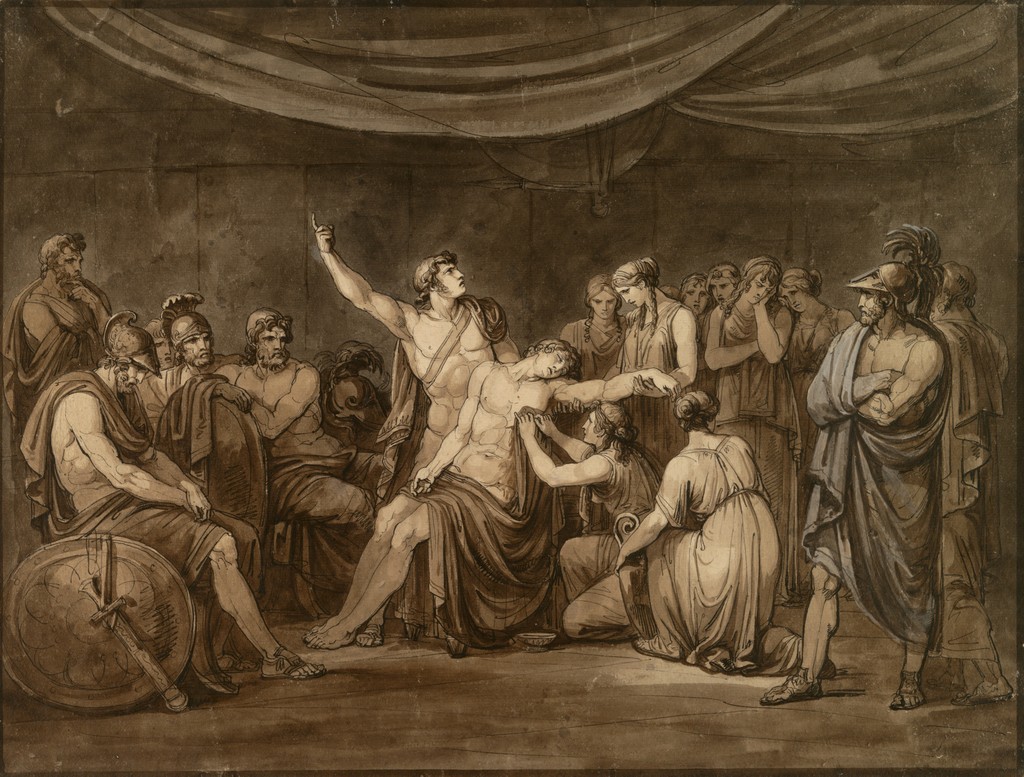
Bartolomeo Pinell “Achilles Swears an Oath to Avenge the Dead Patroclus, Killed by Hector.” 1808, Works on Paper, Yale University Art Gallery, Overall: 41.3 x 54.6cm (16 1/4 x 21 1/2in.); Framed: 64.77 x 77.47 x 3.175cm (25 1/2 x 30 1/2 x 1 1/4in.)
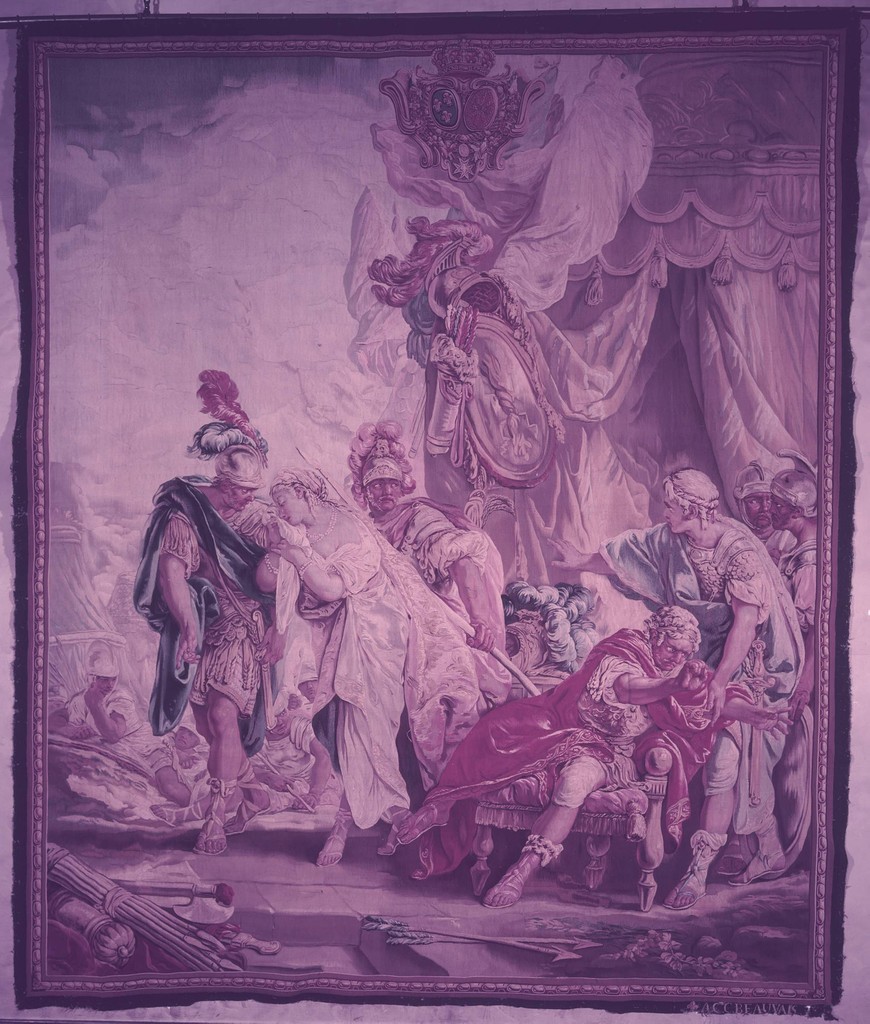
Deshays de Colleville, Jean-Baptiste-Henri “Quarrel of Achilles and Agamemnon, wrath of Achilles, Illiad, Set A” 1729-1765. Beauvais, Textiles-Tapestries, 12’x 10’4’’
Deshays, a french painter, is famous for painting religious and mythological subjects. He adopted the grand manner, a term used to describe paintings that utilize visual metaphor to indicate the nobility of a subject. The theme of this painting is Achilles quarrelling with Agamemnon while his beloved Briseis has been taken away by the heralds Talthybius and Eurybates. We can analyze this painting in two ways. Firstly, this portrait stresses Agamenon’s nobility and his power as he is crowded by men and the only one who sits on a chair. These traits resemble the nobility of Agamemnon and his superiority compared to other characters.
Additionally, Agamemnon conveys his unquestionable authority by letting his man arming with weapons inside the camp. Secondly, by looking closer at the picture, the audience can sense the intimacy between Briseis and Achilles as she grasps Achilles’ hands with nostalgia and reluctance. Adding on, we can see Achilles’ eyesight lingers on Bresis when Agamemnon’s fellows take her. From my perspective, it is quite surprising that these two characters share such a strong bond as Briseis is only a prize of the war allocated to Achilles. When reading about Iliad, I thought about what Achilles cares about is his stubborn sense of honor. Yet, in this picture, seeing them holding hands together like a couple just falls in love with each other, I now feel like Achilles is more like a human rather than a godlike warrior depicted in Iliad as he shares some moral traits in this picture. Hence, the audience at that time can relate themselves with Achilles.
After going over this painting, I still wonder about which character represents Achilles as there is no clear sign of his trait. Later on, I realize that maybe this artwork can be analyzed in different ways by viewing from different perspectives. The one who sits on the chair might also be Achilles himself as he turns over his head and tries not to look at Briseis when Agamemnon’s fellows take her. Interpreting his facial expression, I found this character shows an upset mood which might further justify my idea that he is Achilles.
Overall, I strongly prefer the first interpretation as this explanation presents us with a different Achilles who are now more flesh and blood.
 Weizhuo Jing